













 |
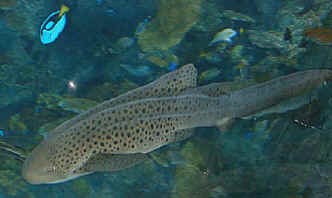
small, gentle shark that can be kept in an aquarium with other fish |
|
it's tail is half its length |
Appearance:
Cylindrical body with prominent ridges on the sides. Tail as along as the rest of body, very low. Head broad, small barbells, and transverse mouth in front of the eyes. Spiracles very big (as large as eyes). Both dorsal fins back to back, whereas the first one is much bigger. Origin of first dorsal fin behind the free rear ends of pectorals, insertion of first dorsal fin above bases of pelvic fins. Second dorsal fin about as large as anal fin.
Coloration:
Grayish brown over entire body, with dark spots in adults. Juveniles with dark saddles, giving more the impression of a dark basic color, with light stripes and spots.
Distribution:
Indo-Western Pacific: South Africa to Red Sea and Pakistan, India, Sri Lanka, Bangladesh, Indonesia, Thailand, Vietnam, Philippines, China, Japan, Australia, New Caledonia, Palau.
Biology:
Lives over the continental and insular shelves. Very common around coral reefs, but little is known about its biology. It is known that this species props up its pectorals in the sand and faces the current with open mouth. Such behavior and its inactivity during the day points towards a more sluggish life style.
Feeding:
Feeds primarily on snails and shells (mollusks), but also on crabs, shrimps and small bony fishes.
Size:
Maximum size about 350cm, average size between 250 and 300cm.
Reproduction:
Egg laying (oviparous). Egg cases are large (17cm long, 8cm wide, 5cm thick). Unknown if the female lays more than one egg at a time, but it is most likely. Hatch size between 20 and 36cm. Males reach sexual maturity between about 150 and 180cm, females around 170cm.
Similar species:
None.
Endangerment:
Unknown. This species is regularly taken in inshore fisheries and a decline is likely.
Danger to humans:
Harmless.