














Nurse Shark
GENERAL DESCRIPTION
The nurse shark is a large, sluggish, bottom-dwelling shark that is generally
harmless. It has very strong jaws, a stout body, and a wide head with obvious
barbells (thin, fleshy, whisker-like organs on the lower jaw in front of the
nostrils that sense touch and taste). The fourth and fifth gill slits are very
close together. The dorsal fins (on the shark's back) are almost the same size
and are rounded. Behind each eye there is a spiracle, an organ that takes in
water used for breathing when the shark rests at the bottom.
The skin is dark gray-brown on top and some nurse sharks, especially the young,
have spots. The nurse shark is smooth to the touch, unlike most sharks.
They are nocturnal hunters that rest during the day in groups. Nurse sharks do
well in captivity.
No one is sure how they got their name; it might be because they make a sucking
sound that is a little like the sound of a nursing baby.
SIZE
Nurse sharks range in size from about 2-13 feet (0.75-4 m) long. The largest are
about 14 feet (4.25 m) long.
TEETH
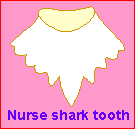 The
nurse shark has thousands of replaceable teeth which are serrated and fan
shaped; they are capable of crushing shellfish. The teeth are arranged in rows
that rotate into position when one is needed (when older ones are broken or
lost).
The
nurse shark has thousands of replaceable teeth which are serrated and fan
shaped; they are capable of crushing shellfish. The teeth are arranged in rows
that rotate into position when one is needed (when older ones are broken or
lost).
DIET AND FEEDING HABITS
Nurse sharks eat bottom-dwelling fish, shrimp, squid, octopus, crabs, sea
snails, lobster, sea urchins, and coral. The barbells (thin, fleshy,
whisker-like organs on the lower jaw in front of the nostrils that sense touch
and taste) help the shark locate potential food. Most hunting is done at night.
NURSE SHARK ATTACKS
The nurse shark is a large, sluggish, docile shark that is generally harmless.
SOCIAL GROUPS
Nurse sharks congregate in schools. They are sluggish or rest during the day,
sometimes piled together on the bottom.
HABITAT
Nurse sharks live in warm waters and are shallow-water sharks (going from the
surface to 230 feet = 70 m deep). They are bottom-dwellers, living near sandy
beaches, mudflats, and sandbars. They are common in coral reefs.
DISTRIBUTION
Nurse sharks are found in the western Atlantic Ocean and the eastern Pacific
Ocean.
REPRODUCTION
The eggs develop inside the body after internal fertilization and hatch within
the body of the mother. Litters consist of 20-30 pups that are tiny replicas of
the adult.
Nurse sharks reach maturity at about 15 to 20 years old.
MIGRATION
Nurse sharks do not migrate as the water becomes cooler, their activity level
simply decreases.
Description
The Nurse Shark has both dorsal fins set far back. She has little eyes and a big nose with fleshy barbells hanging off it which can actually detect prey hidden from view. That's lucky for her because she can't see very well. If you leave her alone she'll leave you alone, but if you pick a fight with her she will most certainly attack you. A Nurse shark has special teeth which it uses for crushing the shells of crabs and mollusks. Nurse sharks replace a row of teeth about every two weeks during warm weather. They are born with spots. But by the time they reach 9 feet they turn grayish or yellowish-brown all over. They live on the bottom of shallow waters in the Western Atlantic as far north as Rhode Island and as far south as Brazil.