














Bull Shark
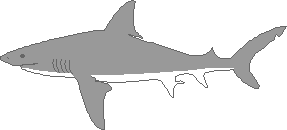
Bull Sharks are gray with an off-white underside. They have a Dull nose, fat body and no dorsal ridge. They are slow swimmers, can breathe while at rest, and grow to about ten feet. They are the only sharks who are just as happy in fresh water as salt water, and have been found as far as 2,000 miles inland. Bull Sharks are world class travelers, and have been sighted in Lake Nicaragua, Guatemala's Lake Yzabal, the Spanish Main and New York, but their favorite hangouts are in shallow waters along the continental shelves. They'll eat just about any kind of fish.
The bull shark (Carcharhinus leucas) Has a square-nose. The bull shark is found in all tropical and subtropical oceans and seas along the coastlines and also in a few fresh water rivers and lakes. The bull shark is the most frequent attacker of people, as it swims in very shallow waters where people swim and is an aggressive shark.
Anatomy: The bull shark has a short snout that is wider than it is long (that's why it's Named that). Its belly is off-white, its top surface is gray, and its eyes are small. The first dorsal fin is much longer and more pointed than the second dorsal fin. The females are larger than the males. On average, adult males are about 7 feet (2.1 m) long weighing 200 pounds (90 kg). Adult females are about 11.5 feet (3.5 m) long weighing 500 pounds (230 kg).
Diet and Teeth: The bull shark eats fish (including other sharks and rays), turtles, birds, mollusks, crustaceans, and dolphins. It will eat almost anything. Bull shark teeth are triangular, serrated (saw-edged), and very sharp.
 |
GENERAL DESCRIPTION
The bull shark has a short snout that is wider than it is long (hence its name).
Its belly is off-white, its top surface is gray, and the eyes are small. The
first dorsal fin is much longer and more pointed than the second dorsal fin. A
pup's fins have black tips, but these marking fade in the adults. The females
are larger than the males. The bull shark is also know as the cub, Ganges,
Nicaragua, river, Swan River Whaler, Zambezi, shovelnose, slipway grey,
square-nose, and Van Rooyen's shark.
TEETH
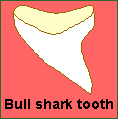 Bull shark teeth are
triangular, serrated (saw-edged), and very sharp.
Bull shark teeth are
triangular, serrated (saw-edged), and very sharp.
The teeth are located in rows which rotate into use as needed. The first two
rows are used in obtaining prey, the other rows rotate into place as they are
needed. As teeth are lost, broken, or worn down, they are replaced by new teeth
that rotate into place.
SIZE
 On average, adult males are
about 7 feet (2.1 m) long weighing 200 pounds (90 kg). Adult females are about
11.5 feet (3.5 m) long weighing 500 pounds (230 kg).
On average, adult males are
about 7 feet (2.1 m) long weighing 200 pounds (90 kg). Adult females are about
11.5 feet (3.5 m) long weighing 500 pounds (230 kg).
DIET AND FEEDING HABITS
The bull shark eats fish (including other sharks and rays), turtles, birds,
mollusks, crustaceans, and dolphins. It will eat almost anything.
BULL SHARK ATTACKS
The bull shark is one of the most frequent attacker of people, as it swims in
very shallow waters where people swim and is an aggressive shark.
HABITAT
The bull shark is found close to shore and can live for a while in fresh water,
frequenting estuaries, rivers and lakes. It has been found up to 1,750 miles
(2800 km) up the Mississippi River in the USA and 2,500 miles (4000 km) up the
Amazon River in Peru. It has been found in Lake Nicaragua (Central America) and
the Zambezi River (Africa).
DISTRIBUTION
The bull shark is found in all tropical and subtropical oceans and seas along
the coastlines and also in a few fresh water rivers and lakes.
REPRODUCTION
Bull sharks are viviparous (like mammals, giving birth to live animals that were
nourished by through a placenta). Litters of 1 to 13 pups are common after a
gestation period of about one year. Pups are about 28 inches (70 cm) long at
birth. Very young bull sharks are frequently found in protected bays near the
mouths of rivers, in briny water
MIGRATION
The South American bull shark migrates about 2,300 miles (3700 km) seasonally,
travelling from the upper Amazon river to the sea.
POPULATION COUNT
The bull shark is a very common shark.