













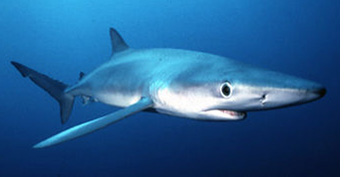
Blue Shark
The blue shark has a long, slender body -- up to 12.5 feet -- with a pointed snout. Its upper body is dark blue, the sides are bright blue, and the belly is nearly white. This type of coloration is known as counter Shading
The blue shark is a pelagic or open ocean, shark. It may be seen in offshore surface waters near San Diego and northern Baja California. Its lower jaw is narrow and lined with long, sharp, serrated teeth. It feeds mainly on fish, but it's not shy like its shallow-water or bottom-dwelling cousins, and can be dangerous to open-water divers.
The blue shark is viviparous and gives birth to live young, or pups. A litter can have as few as four and as many as 100 pups, depending upon the size of the mother.
The blue shark is also called the blue whaler or great blue shark.
Blue sharks grow to be up to 12.5 feet (3.8 m) long.
SWIMMING
The blue shark's sleek, tapered body makes it a graceful swimmer. Its elongated
caudal fin (tail) provides swimming power as the tail moves side-to-side. These
sharks are among the fastest swimming sharks and can even leap out of the water.
They are also probably among the fastest fish. Estimates of their speed varies;
some say that they can swim at about 60 miles per hour (97 kph), while more
conservative estimates are about 22 mph (35 kph). There hasn't been enough
experimentation on their speeds to have an definitive answer.
TEETH
The teeth are pointed and serrated. This enables the shark to catch slippery
squid and fish, the mainstay of its diet.
Sharks' teeth are located in rows which rotate into use as needed. The first two
rows are used in obtaining prey; the other rows rotate into place as they are
needed. As teeth are lost, broken, or worn down, they are replaced by new teeth
that rotate into place.
DIET AND FEEDING HABITS
The blue shark's diet consists mostly of squid, but it will eat almost anything;
it is an opportunistic feeder.
HABITAT AND DISTRIBUTION
Blue sharks are pelagic; they are found in open waters. Like most pelagic
sharks, they are found worldwide.
BLUE SHARK ATTACKS
Blue sharks are considered dangerous, and there have been attacks on people.
MIGRATION
Atlantic blue sharks migrate across the Atlantic Ocean each year, following the
warm Gulf Stream waters on their eastward trip. They travel a circuit from the
Caribbean Sea, along the coast of the USA, east to Europe, south to the African
coast, and back to the Caribbean.
SOCIAL GROUPS
Blue sharks often form large, all-male or all-female schools (groups) which
contain sharks that are about the same size. No one knows why they do this.
POPULATION COUNT
The blue shark is classified as low risk/near endangered.