













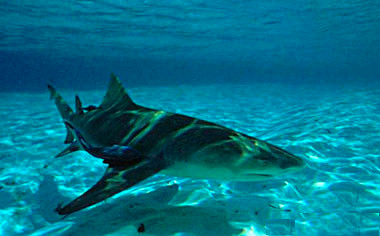
Lemon Shark
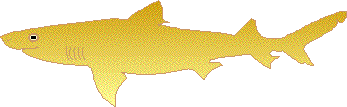
The Lemon Shark is slim and elegant and matures at about 7 feet. At a maximum length of 11 feet it will weigh only about half as much as a tiger shark equally long. It is common in Gulf waters including bays and salt creeks. It can look yellow which is why it is called a Lemon Shark, but can also take on shades of gray or brown with white or yellowish under parts. To identify, look for two almost equal size dorsal fins, a Fat, rounded snout, and narrow, triangular teeth, more pointed and erect in the lower jaw.
 |
GENERAL DESCRIPTION
The lemon shark's back is deep yellow (giving it its name); its belly is off-white. It is used extensively in scientific research since it does well in captivity. It is requiem shark that is fairly common along the southeast coast of the USA.
TEETH
 The
triangular teeth are slightly curved. These long, thin, sharp teeth are designed
to catch slippery fish, the mainstay of the lemon shark's diet.
The
triangular teeth are slightly curved. These long, thin, sharp teeth are designed
to catch slippery fish, the mainstay of the lemon shark's diet.A young lemon shark loses an entire set of teeth, one at a time, every 7-8 days. The teeth are located in rows which rotate into use as needed. The first two rows are used in obtaining prey, the other rows rotate into place as they are needed. As teeth are lost, broken, or worn down, they are replaced by new teeth that rotate into place.
SIZE
Lemon sharks average 8-10 feet (2.45-3.1 m) long. The largest recorded catch was 12 feet long.
DIET AND FEEDING HABITS
It eats mostly fish (including other sharks), but will also eats mollusks and crustaceans.
LEMON SHARK ATTACKS
Lemon sharks have been known to attack people.
HABITAT
It lives near the surface and at moderate depths, frequenting bays, docks, and river mouths.
DISTRIBUTION
The lemon shark is found in the Pacific off Latin and South America, in the Atlantic off the coasts of South America and west Africa, and in the Gulf of Mexico.
REPRODUCTION
Litters consist of about 36 young which are about 18 inches long at birth.